Camo American Flag Best Dad 20oz Tumbler Review
As a designer who spends more time staring at stitch maps than most people care to admit, I approach every new digital embroidery file with a mix of excitement and skepticism. We have all been there: you buy a design based on a slick thumbnail, only to find out the stitch density is a nightmare or the details vanish once the needle hits the fabric. Today, I am breaking down the Camo American Flag Best Dad 20oz Tumbler graphic. While this asset is marketed primarily for sublimation and Tumbler Wraps, my job is to look past the marketing and see how it translates into the tactile world of thread and fabric for real-world projects.
First Impressions: Mood and Visual Personality
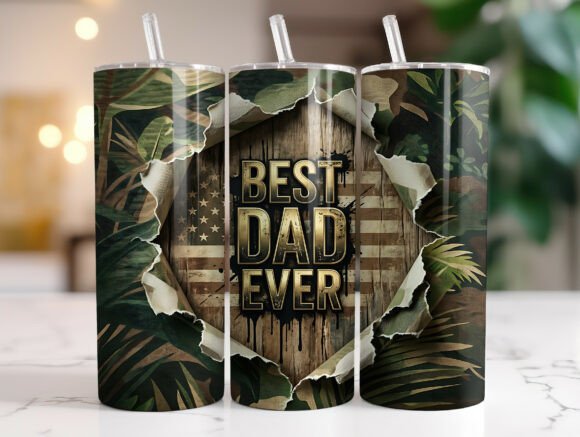
When I first pulled up the high-resolution PNG files included in this download, the immediate vibe was rugged yet celebratory. The combination of camouflage patterns with the American flag creates a specific aesthetic that screams "outdoorsy patriot." It is not delicate; it is bold. For an embroidery project, this visual personality suggests strength and durability. The layout, sized at 9.3″ x 8.2″, offers a substantial canvas. In the world of custom apparel, a design of this scale usually demands a large hoop, but the composition is balanced enough that it could be scaled down for smaller applications without losing its identity.
The "Best Dad" text element is crucial here. In many generic designs, lettering is an afterthought, often too thin to stitch well or poorly kerned. In this graphic, the typography feels integrated into the camo background rather than just floating on top. For a machine embroidery adaptation, this means we are looking at a design that requires careful planning regarding thread colors to ensure the text pops against the busy background.
Real-World Application: Beyond the Tumbler
Although the product title specifies a 20oz tumbler and the files are optimized for Graphics on curved surfaces, my mind immediately went to where this design would shine in a physical stitch context. Imagine preparing a custom order for a client who runs a small hunting lodge or an outdoor gear shop. This design is perfect for a heavy-duty embroidered patch that can be sewn onto a tactical vest, a backpack, or a work shirt.
I recently worked on a similar concept for a sweatshirt embroidery project. If I were to adapt this camo flag design for a men's hoodie, the key would be managing the background. Instead of stitching the entire camouflage fill, which would create a stiff, cardboard-like texture due to high stitch density, I would recommend using the graphic as a guide for an applique method. You could use actual camo fabric for the background and only stitch the flag stripes and the "Best Dad" lettering. This approach preserves the fabric texture and keeps the garment wearable and soft, which is essential for a personalized gift meant to be worn often.
For Etsy sellers and craft business owners, this design also holds potential for home decor. A tote bag design featuring this motif would sell well around Father's Day or the Fourth of July. However, because the original file is a PNG intended for printing, you must digitize it properly or trace it for stitching. Do not attempt to print this directly onto fabric and then stitch over it unless you are doing a specific mixed-media technique, as the ink may bleed or crack.
Technical Considerations for Stitching
Here is where we need to be realistic. Since this product includes straight and tapered PNGs for sublimation, it is not a native machine embroidery design file (like PES or DST). This is a critical distinction. If you are an embroiderer, you cannot simply load this into your machine. You will need to use digitizing software to convert the graphic into stitches, or hire a digitizer.
If you choose to digitize this yourself, pay close attention to the camouflage elements. Camo patterns rely on organic, jagged shapes. In embroidery, these can become muddy if the running stitch or fill stitch directions are not varied. I suggest simplifying the camo shapes slightly to prevent thread breaks and bird nesting. Furthermore, the transition between the red, white, and blue of the flag and the greens and browns of the camo requires sharp color changes. Underlay stitches will be your best friend here to prevent the dark camo threads from peeking through the lighter flag sections.
Regarding hoop size, the original dimensions are quite large. If you plan to stitch this on a cap, you will likely need to resize the design significantly. Be warned: shrinking detailed graphics can lead to lost definition. The tiny leaves in the camo pattern might merge into a green blob if reduced below 3 inches. Always test the design on scrap fabric first, especially when working with textured materials like pique polo shirts or thick fleece.
Fabric Choices and Stability
The success of this design heavily depends on your material choice. On a stretchy fabric like a baby onesie, this heavy, patriotic theme might feel out of place visually, but more importantly, the density required to cover the area could cause puckering. For baby embroidery, I would advise using this motif only as a small chest pocket accent, perhaps omitting the full camo background entirely.
Conversely, on stable fabrics like canvas twill, denim, or heavy cotton, this design will excel. These materials provide the necessary support for the wide coverage area. When working on dark fabrics, remember that the white portions of the flag will need a solid white underlay or perhaps a white fabric applique base to maintain brightness. Without this, your "stars and stripes" might look gray and dull.
Stabilizer selection is non-negotiable. For a project of this magnitude, a cut-away stabilizer is mandatory if the item will be washed frequently. Tear-away might seem easier, but it risks leaving fibers behind in the dense stitching areas, leading to a messy finished product over time. If you are making a holiday embroidery piece for a wall hanging that won't be washed, tear-away is acceptable, but for commercial embroidery items like uniforms or bags, always prioritize longevity.
Commercial Viability and Brand Trust
For small shop product lines, consistency is key. If you are building a brand around patriotic or outdoor-themed goods, the Camo American Flag Best Dad 20oz Tumbler graphic offers a strong starting point for your visual assets. However, since this is sold as a digital download for printing, selling stitched versions requires you to do the legwork of digitizing. This extra step actually adds value to your handmade product. Customers appreciate the effort of custom stitching over mass-printed transfers.
Before listing items on your online store, check the licensing terms provided with the download. Some creators allow unlimited commercial use for physical goods but restrict the resale of the digital file itself. Ensuring you are compliant protects your craft business from legal headaches. Additionally, consider creating printable mockups of your stitched versions to show customers exactly how the thread interacts with the fabric, setting realistic expectations for the final look.
Final Verdict for Makers
The Camo American Flag Best Dad 20oz Tumbler is a versatile graphic with strong thematic appeal. While it is engineered for sublimation on tumblers, its bold composition makes it a prime candidate for adaptation into high-quality embroidery projects. Whether you are crafting a rugged apron for a grill master, a pillow cover for a cabin, or a limited run of patches for a local club, the potential is there. Just remember: respect the medium. What works in ink on a polymer coating behaves differently in thread on cotton. Take the time to digitize wisely, choose your stabilizers carefully, and you will turn this digital asset into a tangible piece of art that customers will treasure.